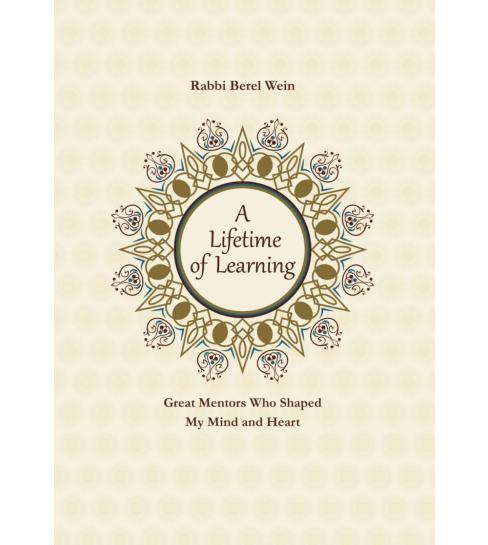
Rabbi Berel Wein zt"l — historian, storyteller, teacher to generations — completed A Lifetime of Learning with his last reserves of strength in the summer of 2025. His editor worked with him in his Jerusalem home, reading chapters aloud as his eyesight failed and his health declined. He would nod, smile, sometimes laugh — reliving the people he loved. He pushed her to work faster. He needed to finish.
He finished. And then, within weeks, he was gone.
This is that book. It is the most personal thing Rabbi Wein ever wrote — and it may be the most important.
The Giants Behind the Giant
Rabbi Wein grew up in Chicago, the son of a quiet Lithuanian Rav who had sat in Reb Shimon Shkop's yeshiva in Grodno. His maternal grandfather, Rabbi Chaim Tzvi HaLevy Rubenstein, had learned in Volozhin under the Netziv and Reb Chaim Brisker. His father-in-law had been a foster child of the Chofetz Chaim.
In sixteen chapters, Rabbi Wein brings these people back to life — not as biography, not as hagiography, but as vivid memory. You will meet the Rosh Yeshiva whose face looked exactly like how Rabbi Wein imagined the Kohen Gadol. The gadol who served as a shammes in San Francisco before becoming Rosh Yeshiva of Torah Vodaath. The Satmar Rav — whom Rabbi Wein feared meeting — who showed up unannounced at his Miami Beach home, validated his mikveh, used it himself the next morning, and taught him a lesson about rabbanus he never forgot.
A Lost World, Witnessed from the Back
Rabbi Wein understood himself as a bridge — one of the last people alive with personal memories of the final generation of Lithuanian Jewry in America. He saw that world, as he writes, "from the back," the way Rabbi Yehuda HaNasi saw Rabi Meir. And he knew that seeing Torah in a living person is something no book can replicate.
The mentors in these pages span the full landscape of twentieth-century Torah greatness: his grandfather Rabbi Chaim Tzvi Rubenstein, who founded what became a century-old yeshiva, gave away his entire life insurance policy to the Vaad Hahatzalah, and never locked his front door; his father Rabbi Zev Wein, who as a teenager snuck across the Polish border to learn by Reb Shimon Shkop and was sent alone by train to Reb Chaim Ozer at midnight; Rabbi Yaakov Kamenetsky, who radiated chein and truth; Rabbi Dr. Joseph B. Soloveitchik, who told a young Rabbi Wein that his problems were the same ones his grandfather had in Brisk and were unsolvable; and the Ponevezher Rav, who rebuilt a world in Bnei Brak with a vision that defied every rational calculation.
A Mesorah in Every Chapter
Rabbi Wein was constitutionally incapable of the generic. Every portrait here is precise, funny, honest, and alive. He does not judge these men's public positions or controversies. He shares what they taught him personally — by example, by story, by how they treated a young rabbi who walked into their lives.
The result is a book that parents will want their children to read, that rabbis and teachers will return to for chizuk, and that anyone who cares about the continuity of the Jewish People will find indispensable. Rabbi Wein received a mesorah from giants. He poured it into this book. Now it belongs to you.
 1-888-342-4537